Saturday, July 9, 2016

Cemetery Series: Cemetery Geology

Cortland Rural Cemetery. Photo credit to PBM.
Cemeteries serve as memorials to our loved one’s lives and stories, but the stories of those who have passed on aren’t the only ones that can be found in a graveyard. Tales of geology, environmental health, and wildlife are also hidden there. Today I’m going to share some of the geological stories of headstones.
Kings Chapel Burying Ground. Photo by author.

Author's image.
Here are a few popular stones used in cemeteries over the centuries.

Granite


Granite. A creative commons image.
Granite is a durable igneous rock that makes for a long lasting tombstone. People began to use granite for cemetery monuments in the 1860s and it remains a popular stone for memorials to this day. Granite is formed from magma which cooled about ten miles below the earth’s surface. Whenever granite shows up at the surface of the earth that means the ten miles of earth covering it have eroded away over time leaving the granite visible. North Carolina is home to the world’s largest open-faced granite quarry. All stone there is mined directly from the surface. Granite comes in a variety of consistencies and colors determined by the composition of the minerals in the rock. Quartz, mica, and various feldspars make up most of granite and give it a characteristic speckled look. Sometimes granite contains xenoliths, sections of foreign rocks which did not melt and integrate into granite smoothly, but remained their own species of rock.

Granite holds up well under weathering, though the mica in it may degrade leaving it pitted. Stains from soot can darken granite, and lichens, moss, and ivy growing on the stone can change its appearance as well.

Quincy Granite Scandal


In the 19th century a dark variety of granite found near Boston known as Quincy granite was all the rage. Quincy granite got its dark color from some of its feldspars which were degrading into clay in a process called kaolinization. Quincy granite was used in many buildings and monuments until people found out that much of the stone being sold wasn’t actually Quincy granite at all, but a lighter granite rubbed with carbon and oil to make it darker. This dye eventually faded, leaving the stones splotchy and the customers disgruntled. After this scam no one wanted anything to do with Quincy granite.

Sandstone

Prepared sandstone sample. A public domain image.
While granite (non-dyed) holds up well under weathering, sandstone is probably the least durable rock used in cemeteries. Whole layers easily flake off as wind and rain wear down the stone. Monuments and headstones made from sandstone were popular from 1650-1890.
Monument at Cortland Rural Cemetery. Photo credit to PBM.

Sandstone is a sedimentary rock formed from sandy broken up pieces of other rocks deposited at the bottom of a river or sea. When these deposits were subjected to intense pressure, they condensed into a new rock, sandstone. The color of sandstone differs widely across sandstone species depending on where they formed and how they weathered. Sandstone is often striped with different colored sediment. In addition to miscellaneous rock pieces, sandstone often contains quartz and feldspar, and is held together by silica, calcite, or iron oxides.

Limestone

Limestone quarry. A creative commons image.
Limestone is similar to sandstone, but it holds up to weathering better and it is formed from calcite and silicate sediment, not sand. Impurities in the sediment will create darker limestone, but lighter varieties with fewer impurities are the most prized. The calcite and silicate either directly precipitate from the seawater or are obtained from the abandoned shells of sea creatures lying on the ocean floor. Some limestone contains fossils of these organisms. Limestone commonly forms in tropical or subtropical seas where calcite and silicate are abundant.
Monument at Cortland Rural Cemetery. Photo credit to PBM.

Most calcite and silicate sediments are compressed into limestone in the same way sand is compressed into sandstone. Some limestones even contain visible sedimentary layers like sandstone does. However, oolitic limestone, also used for headstones, forms in a different way and doesn’t contain these layers. Small grains of sand roll about the sea floor collecting calcite, which acts as a matrix to bind these grains together, and voilĂ , oolitic limestone is formed.

Ooids in a thin-section. A public domain image. 

Headstones made of limestone were most popular from 1780-1930, but limestone was used much earlier to make the first sarcophagi. Sarcophagus literally means “flesh eat,” a rather disturbing name which stems from the unusual limestone used to make sarcophagi which ate away at human flesh.


Sarcophagus of Pharaoh Merenptah. A creative commons image.

Marble

 Marble. A creative commons image.
After limestone is metamorphosized at high temperatures and pressures it becomes marble. The purest marble is perfectly white and has a sugary texture. Marble is highly sought after for its elegant beauty. Marble may be beautiful, but over time its glory fades as carbonization brought on by rainfall causes its surface to recede, rendering headstone inscriptions illegible. In an effort to combat the lost lettering, lead letters were attached with pins to marble monuments, but eventually surface recession caused these letters to fall out. Marble is also easily stained with lichens or soot.

Author's own image.
Marble was in vogue from 1780-1930. The world’s most prized marble has no impurities and comes from Carrara, Italy. Michelangelo used Carrara marble to carve his famous statue of David, and Leonardo Da Vinci helped a quarrying machine for this site. Today, the supply of Carrara marble is running low. Oddly enough, the world’s cheapest marble, Italian grey marble, also hails from Carrara.
Monument from Cortland Rural Cemetery. Photo credit to PBM.

The United States contains several marble sources on the east coast, the most popular sites are Barre, Vermont and Knoxville, Tennessee. The land which now forms Vermont and Tennessee was once the bottom of a tropical sea, which provided the right conditions for limestone formation. This limestone then metamorphosized into marble. 
Monument from Cortland Rural Cemetery. Photo credit to PBM.

Slate

Slate. A public domain image.
Slate, like marble, is sedimentary rock that was metamorphosized to become a new variety of stone. Unlike marble, slate is formed from sedimentary rock made of mud and possibly volcanic ash, not limestone. Slate tends to be dark grey or tinted deep purple or green from the volcanic ash. It is layered in thin sheets that peel apart easily. Gravestones made of slate are often coated with a protective material to prevent water from getting between the layers and pushing them apart. Once the coating is on, slate weathers well given its hard nature. Being hard isn’t always good for a gravestone, however, as it is highly difficult to carve inscriptions into slate. Still, professional gravestone carvers in the later 1600s and early 1700s made impressive carvings on slate of death imagery such as skulls, hourglasses and cherubs. Carved slate gravestones in New England are a crucial relics of Puritan art.
Carved slate gravestone from King's Chapel Burying Ground. Photo by author.


Carved slate gravestone from King's Chapel Burying Ground. Photo by author.
Judge Hathorne's grave. Salem, MA. Photo by author.

Modern Additions

Larvikite and Gabbro are the most common stones used to make grave markers.

Larvikite. A public domain image.

Larvikite is a coarse grained igneous rock with an abundance of feldspars, which give it an iridescent shine. Most larvikite is mined in Scandinavia. It is still unclear how larvikite will weather since most gravestones made of it haven’t been up very long.


Gabbro. A public domain image.

Gabbro is also an igneous rock that appears dark grey, but turns black with polish. Molten black and white feldspars form this rock, which weathers easily when exposed to water. Gabbro is often mistaken for, and even sold as, black granite. One beautiful variety of Gabbro, black galaxy, is flecked with bronzite which gives the stone the aura of a starry sky at night.

Gravestones and monuments help us to honor our loved ones and give cemeteries their characteristic beauty. But how do these stones and what’s underneath them impact the world around them? Stay tuned for the next installment of the Cemetery Series: Death and the Environment.
Monument at Cortland Rural Cemetery. Photo credit to PBM.

Note:
In this post I used the terms gravestone, headstone, grave marker and tombstone interchangeably. By common usage, all refer to some type of burial marker. However, gravestones, headstones, grave markers, and tombstones actually are specific terms which refer to different styles of burial markers. Here is a link to a page which explains the exact definition of these terms for those who are interested. 

Sources.

Friday, July 1, 2016

Zika

The mosquito-transmitted virus Zika has been getting world-wide attention since the World Health Organization’s (WHO) announcement in February that it is a national health concern. More recently, the Zika case in New Jersey is prompting discussion about this disease in the United States. What effects does Zika have on humans? What does this mean to people around the world? What can we do to stop Zika?

An enlarged model from the American Museum of Natural History(AMNH) of Aedes aegypti,the mosquito which transmits Zika.  
Photo was taken on June 30, 2016 by author at AMNH's SciCafe event.

An average individual with no immuno-compromising disorders contracted Zika, nothing much would happen. Maybe the individual would get a headache, conjunctivitis, joint pain, or a mild fever, irritating, but not bad enough to report or go to the hospital. Most people (80%) with Zika don’t even know they have it, and completely recover after the virus leaves the body a few months later. There may be a slight connection between Guillain-BarrĂ© syndrome, which can cause severe paralysis, and Zika, but the connection is unproven and does not render Zika a national concern. Why then are people, WHO included, so worried about Zika?

Zika may go virtually unnoticed in adults, but if a fetus contacts Zika from the mother during gestation, it can develop severe birth defects such as microcephaly, increased calcification in the brain, and other motor and behavioral complications. Zika can cause birth defects no matter what trimester of pregnancy it is contracted in.
If Zika continues to spread, it could severely damage human populations. Dr. W. Ian Lipkin, John Snow Professor and Director of the Center of Infection and Immunity at Columbia University, stated at the American Museum of Natural History’s Zika SciCafe on June 30, 2016 that if there is any way to wreak havoc on a species, it is to prevent it from reproducing properly, and that’s what Zika is doing to us.

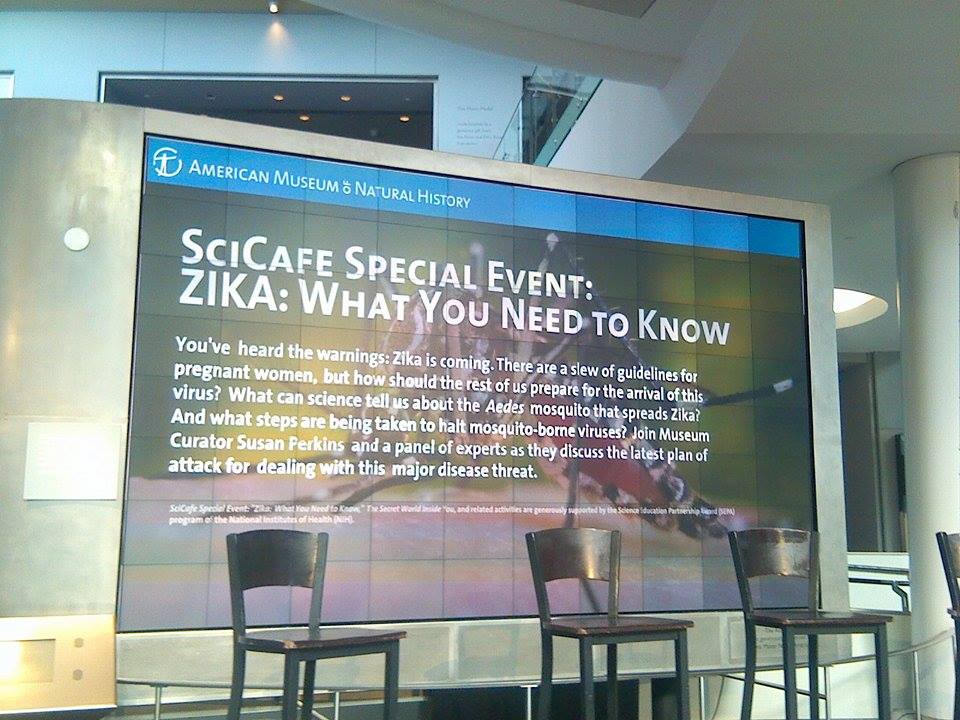
AMNH SciCafe.  Panelists at the cafe were:
 Dr. W. Ian Lipkin; Catherine Spong, MD; and Jay K. Varma MD.
Event moderator was Dr. Susan Perkins.
Photo taken at the event by author
Now, this virus with barely any noticeable symptoms sounds quite alarming, but thankfully, Zika has not yet overtaken the whole world. The virus remains restricted to southern climates such as those in South America or Africa. International travel can result in cases far from the south, however, and there have been 233 cases were reported in New York City as of July 1, 2016. Healthcare providers everywhere must be prepared to treat and prevent Zika infections. One concern about Zika being carried back to countries like the United States by travelers is that a northern relative of Aedes aegypti, the mosquito which carries Zika, will bite someone with Zika, and then continue to spread the virus to more and more people, eventually interfering with their ability to reproduce.

Where Did Zika Come From?

 Most people, myself included, only heard of Zika recently, but it has likely been around for a long time, and probably passed unnoticed until due to its generally mild symptoms. The first known case occurred in Zika forest in Uganda in the 1940s and generated little attention. In 2007, there was an outbreak on Yap Island, Micronesia which effected a high percentage of the population putting Zika on the international radar.

How Does Zika Spread?

 The main form of Zika transmission is through mosquito bites. The infection process begins when a mosquito ingests Zika-infested blood. The virus then enters the mosquito’s system, including its saliva, which transfers the virus into the next human it bites. Not all mosquitos are good transmitters of Zika. Aedes aegypti is the species of southern, aggressive, day-biting mosquito that can breed in very small amounts of stagnant water and spreads Zika. (We don’t have that species here in New York City.)

Zika can also be transmitted sexually and through blood contact. Zika remains in an infected woman’s body for about two months, and in an infected man’s semen for even longer. To prevent spreading Zika this way and causing birth defects in unborn children, couples traveling to Zika heavy-zones should be tested for Zika and avoid unprotected sex for six months, when they will both be free of the virus.

The blood contact method of transmission means Zika could be spread through blood transfusions or organ donations.

Testing for Zika

Zika is a virus, meaning it is a small packet of genetic information surrounded by proteins that can only reproduce inside of a cell. Viruses attach themselves to their host cell, penetrate the cell, unleash their genetic material, replicate it to produce new viruses, and kill the host cell.

Informational flyer from the NYC Department of Health about Zika.
Photo taken by author.
There are several ways to test for a viral infection like Zika. The preferred method is to run a polymerase chain reaction (PCR) test to determine if there is genetic evidence of the virus in the individual. The second method is to test for presence of the virus’s antibodies. The genetic test is highly accurate at determining if Zika is present, but the antibody test is much less accurate and can test positive even if another virus, not Zika, is present. The antibody test is only used because a viral infection consists of two stages: one where viral genetic information is present in the individual and one where viral antibodies are present, but not the genetic information. Between these stages is a window of time where neither genetic information nor antibodies are present. This means both viral tests are good at determining if a virus is present, but not as good at determining if it is absent. If the test comes out negative, there is still a chance that the individual could have Zika. Catherine Spong MD, Acting Director of the Eunice Kennedy Shriver National Institute of Child Health and Human Development at the National Institutes of Health and speaker at the American Museum of Natural History’s Zika SciCafe, suggests careful monitoring of pregnant women who have Zika, and those who may have contracted Zika throughout their term for the health of the baby.

Zika SciCafe at AMNH. Photo taken by author at the event.

Prevention

 Vaccines for Zika are still being developed and tested. Even once vaccines are on the market they won’t completely eradicate the disease. There are multiple forms of Zika, and while the vaccine may successfully prevent one form, it may actually amplify the effects of a different strain. Being infected to other viral infections similar to Zika, like Dengue, can also amplify the symptoms of Zika.

Cullman Hall of the Universe at AMNH where the Zika SciCafe was held.
Photo taken by author at the event.
Another way to prevent Zika is avoid getting bitten by mosquitos. On a personal level this means wearing bug spray, long sleeved shirts and pants, putting up bug screens, and removing standing water. On a governmental scale, as Jay K. Varma MD, Deputy Commissioner for Disease Control at the New York City Department of Health and Mental Hygiene, explained at the American Museum of Natural History’s Zika SciCafe, this means activating new mosquito control programs that include putting chemicals in standing water which kill mosquito larva, spraying to kill adults, and informing the public of how to stay safe.

Here are some websites with more information on Zika:


Monday, April 25, 2016

The Importance of Images: Scientific Illustration and Photography


An etching of Caiman crocodilus and Anilius scytale by Maria Sibylla Merian
Engraver: Joseph Mulder. A public domain image.
A picture can tell the story of a thousand words. While many people may balk at reading a dense scientific article about Caiman crocodilus or Anilius scytale most of them would be happy to look at images of these animals. Images are one of the best ways to make science accessible and understandable for both laypeople and scientists.

Today illustrations and photographs are used to supplement scientific texts, but since photography didn’t exist, or was inaccessible for a large chunk of scientific history, only illustrations were used.

Woodcut print by Thomas Bewick from A History of British Birds (1797)
A public domain image
The European[1] invention of the printing press during the middle of the 15th century, as well as the advent of perspective drawing and increasing popularity of realism made the first scientific illustrations possible. The earliest illustrations were hand drawn into printed books, but as soon as illustrations could be printed and mass produced those were used instead. Often multiple people would collaborate to create an illustration, the scientist/author, the illustrator, and the printmaker. The most popular methods of printing scientific images were woodcut printing, engraving, and etching.

Copper engraving from Metamorphosis insectorum Surinamensium by  Maria Sibylla Merian 
Engraver: Joseph Mulder. A public domain image.
Umbrella Squid. Artist: unknown.
A public domain image.
American Pennyroyal woodcut print
artist: unknown. A public domain image
Most modern illustrators don’t use these printing methods anymore, but instead rely on sketches and digital touch-up methods.
When photography emerged in the 1800s it was quickly utilized by scientists. Even the earliest forms of photography, like cyanotypes and daguerreotypes were used to photograph algae and solar eclipses for scientific purposes. Science and photography have always been closely intertwined since photography is practically a science itself. Photography, especially modern digital photography, does have some benefits over illustration.
Cyanotype photograph of algae by Anna Atkins
A public domain image.
  • Photography is more accessible to the average person, practically anyone can use a camera at an amateur level, but it takes much more work to become an amateur illustrator.   
  • It takes less than a second to take a photograph, which makes it easier to accurately capture the images in the field.
  • Videos can be used to show movement that illustration can’t capture as well. 
  • Photographs can capture images not visible to the human eye. Rosalind Franklin took pictures using technology that captured invisible X-ray beams, which allowed the shape of DNA to be determined.  
  • Scientists can use motion sensor cameras placed in a study area to observe animals, and to determine what species are present in a certain area without long hours of in-person research, something illustration could never do.
  • Photography captures images as they exist in real life, the artist’s possible error in subject interpretation is not an issue.
Public domain photo provided by NASA/NSSDC

      Still, scientific illustration isn’t dead, there are still some things a drawn image can do that photography can’t.            
                                                                                               
Saturn 1874. Artist: Étienne Léopold Trouvelot.
A public domain image.

Disarticulation of the Four Fingers. Artist: Jean-Baptiste LĂ©veillĂ©.
A public domain image.

  • Illustrators can simplify their subject matter or emphasize important details to make complex subjects like anatomy easier to understand.
  • They can make objects transparent to do things like better show the placement of organs in the body.  
  • Illustrators can draw study skins from museum collections in life-like positions, which is great when dealing with endangered or extinct species which are near to impossible to photograph in nature.
  • Illustrators can use data from fossils to create images of ancient animals and plants as if they were still living.Illustrations show a certain sensitivity to the subject matter, lushness of color and simple layout that few photographs manage to capture. They are the ideal mixture of art and science.
Thunder and Lightning: Weather Past, Present, Future by Lauren Redniss
Author's own photo.
Artistic illustrations for popular science books, like those in Lauren Redniss’ books Thunder and Lightning: Weather Past, Present, Future and Radioactive: Marie and Pierre Curie: A Tale of Love and Fallout capture the drama and feeling of a storm and the challenge and excitement of the Curie’s lives in a way photography or even more literally accurate drawings could not.

My etching of the Opah.
About a month ago I made my own scientific illustration as part of a workshop at the American Museum of Natural History. I choose to draw and etch the Opah (Lampris guttatus, a gigantic and warm-blooded fish). I noticed that after making the etching I could remember almost exactly how the Opah looked. Observing the Opah closely enough to draw it helped me to understand the fish on a deeper level than I would have if I just read about it. Illustrations help both the viewers and the artists understand something on a deeper level than words can express.


[1] Printing was invented in China and Korea much earlier on, in the 11th and 13th centuries respectively. Europe was late to the printing game, though they did advance printing technology and use water resistant inks.

Sunday, March 13, 2016

Musical Genes


There’s a popular idea going around that if someone has any musical talent, s/he were magically born with that ability. A more accurate way to put it would be that most of us are born with the ability to make and/or enjoy music. [1]  We are the only species on earth the puts energy into making and listening to a series of tones and rhythms with no directly tangible meaning. Even songbirds tunes have a specified purpose and meaning, such as attracting mates or staking out territory. The bird’s beautiful trills are largely instinctual, programmed into their nervous system since birth. We humans can write original music and improvise. But why? Why are humans obsessed with music? Why do we even bother to spend time making and listening to music at all?
Sheet music.
 Creative commons image

Perhaps humans evolved into a music-loving group because we are social creatures and music is way to communicate and bond with one another. Maybe musical ability is the product of sexual selection, being musically gifted can be seen as attractive. It’s possible that music doesn’t give us any evolutionary advantages at all - we merely like the sound, repetition, and comfort of music.
DNA Helix.
Creative commons image

Another theory is that early language was combined with music, but gradually the two separated. The Neanderthals are suspected to have communicated through tonal sounds similar to singing, but gradually phonetic language became dominate as it allowed early hominins to be more articulate. Some languages today, like Mandarin Chinese are still highly tonal.

People who grew up speaking tonal languages, such as Mandarin Chinese, are more likely to have perfect pitch than those whose first language was non-tonal. Some studies show there is a gene for perfect pitch, but this claim is disputed. Perfect pitch is more of a combination of genetic advantage and the environment. Actually every person (with the exception of those with amusia, or hearing loss) can hear pitches correctly, it’s just the naming and matching of these pitches that confuses some of us. It’s odd that we can hear pitches but not name or reproduce them, that’s almost like being able to see colors, but not being able to name or match them. Really, instead of wondering why some people have perfect pitch and others don’t we should be wondering why all of us don’t have perfect pitch.

Sometimes specific genes of musicians can influence their ability. For example, having flexible or large hands can help a pianist or violinist play more complex passages. Paganini, a famous violinist in the early 1800s, may partially owe his success to Ehlers-Danlos syndrome, a genetic disease that prevents collagen formation. Collagen strengthens ligaments, with this strength comes stiffness.

Paganini drawing  by Ingres
Creative commons image.
Without collagen Paganini could stretch his hands way more than the average person, allowing him to accomplish incredible feats on the violin. Ehlers-Danlos might have been a blessing to Paganini in some ways, but the disease may have also contributed to Paganini’s early death. Genetic problems can also hinder musicians. Schumann suffered from focal dystonia, a muscle loss disorder that prevented him from playing some pieces.

These genetic advantages/disadvantages influence physical ability to play music, but not musicality itself. While the idea that specific genes program our musicality is likely just a rumor, the human race as a whole may have a “musical gene.” Otherwise why would we be the only species that makes music? What genes these are and how they work is unknown.

Even if there is no genetic basis for musicality, scientists have found ways to make our genes musical by coding songs into bacterial DNA. A Chopin nocturne was coded into DNA, and strangely the sequence resembled that of the gene for RNA polymerase, which is needed for transcribing DNA. Genetic sequences have also been coded into songs by assigning each base a note (A, G, C, and E).

Sources.


[1] People with disorders such as amusia, or hearing loss may not enjoy music.

Monday, March 7, 2016

Museum Collections

 When I look at the New York City landscape around me I notice how much of it is covered with cement. It wasn’t always this way. Even now bustling Manhattan used to be rural. It makes me wonder, how has urbanization over the past century changed our environment?

Wouldn’t it be nice if we could go back fifty or a hundred years and scientifically compare their environment to ours now?

It ends up we can do just that.

Well, not exactly. Time travel has not been invented (yet!), but scientists do have a way of preserving pieces of the past for future study. Museums and scientific institutions around the world like the Smithsonian, the American Museum of Natural History, and the Natural History Museum, London, have been collecting specimens of fish, birds, invertebrates, reptiles and amphibians, and mammals for many years. These collections document biodiversity over time and across the globe.

Having these collections is a great asset to science. Let’s say a scientist wants to know how urbanization is effecting different species. The scientist could look at specimens of many different species collected from an area that was once rural but is now urbanized and examine any changes in the specimens and populations they were collected from. Maybe this scientist decides to focus how urbanization has effected one particular species. Then s/he could look a specimens of this species from different areas, and compare populations of this species over both space and time.

Once we know how urbanization has effected a species, we can use this data to predict how further development will continue to effect it in the future. Knowing what happened in the past can help people realize what needs to change if we want to maintain a healthy environment. We can use this information to develop good environmental policies and policies for conservation.

It’s pretty cool that museum collections can be used to study environmental health, but that’s not the only way collections are used. Here are a few more ways we can use species collections:

o   To study evolution. Maybe during urbanization, one population of a particular species became isolated. Using specimens collected from the original population and the isolated one, researchers can see if the populations change enough to be considered different species or different subspecies.
o   To study genetics. DNA can be obtained from tissue samples and from the skins of specimens, as long as they weren’t preserved in formalin. Today we can obtain DNA from specimens collected when people barely even knew what DNA was! Who knows what information old collections will provide scientists in the future.
o   To study disease, contaminates and parasites and how they effect a species.
o   To identify unknown species using DNA or morphology.
o   To study the diet of a species and how it changes.

The interesting thing about collections is that they are always being used in new ways. Early collectors probably had no idea the specimens they collected would be used to study the effects of urbanization. Not too long ago no one thought we would be using DNA from specimens for science, but now that is common practice. Future scientists will probably use specimens we collect today in ways on one could dream of now.

Thanks to Neil Duncan and Nuala Caomhanach at the American Museum of Natural History for helping me research for this post.