The mosquito-transmitted
virus Zika has been getting world-wide attention since the World Health Organization’s (WHO) announcement in February that it is a national health
concern. More recently, the Zika case in New Jersey is prompting discussion
about this disease in the United States. What effects does Zika have on humans?
What does this mean to people around the world? What can we do to stop Zika?
 |
An enlarged model from the American Museum of Natural History(AMNH) of Aedes aegypti,the mosquito which transmits Zika.
Photo was taken on June 30, 2016 by author at AMNH's SciCafe event.
|
An average individual
with no immuno-compromising disorders contracted Zika, nothing much would happen.
Maybe the individual would get a headache, conjunctivitis, joint pain, or a
mild fever, irritating, but not bad enough to report or go to the hospital.
Most people (80%) with Zika don’t even know they have it, and completely
recover after the virus leaves the body a few months later. There may be a
slight connection between Guillain-Barré syndrome, which can cause severe
paralysis, and Zika, but the connection is unproven and does not render Zika a
national concern. Why then are people, WHO included, so worried about Zika?
Zika may go virtually
unnoticed in adults, but if a fetus contacts Zika from the mother during
gestation, it can develop severe birth defects such as microcephaly, increased
calcification in the brain, and other motor and behavioral complications. Zika
can cause birth defects no matter what trimester of pregnancy it is contracted
in.
If Zika continues to
spread, it could severely damage human populations. Dr. W. Ian Lipkin, John
Snow Professor and Director of the Center of Infection and Immunity at Columbia
University, stated at the American Museum of Natural History’s Zika SciCafe on
June 30, 2016 that if there is any way to wreak havoc on a species, it is to
prevent it from reproducing properly, and that’s what Zika is doing to us.
 |
| AMNH SciCafe. Panelists at the cafe were: Dr. W. Ian Lipkin; Catherine Spong, MD; and Jay K. Varma MD. Event moderator was Dr. Susan Perkins. Photo taken at the event by author |
Now, this virus with
barely any noticeable symptoms sounds quite alarming, but thankfully, Zika has
not yet overtaken the whole world. The virus remains restricted to southern
climates such as those in South America or Africa. International travel can
result in cases far from the south, however, and there have been 233 cases were
reported in New York City as of July 1, 2016. Healthcare providers everywhere
must be prepared to treat and prevent Zika infections. One concern about Zika
being carried back to countries like the United States by travelers is that a
northern relative of Aedes aegypti,
the mosquito which carries Zika, will bite someone with Zika, and then continue
to spread the virus to more and more people, eventually interfering with their
ability to reproduce.
Where Did Zika Come From?
Most people, myself
included, only heard of Zika recently, but it has likely been around for a long
time, and probably passed unnoticed until due to its generally mild symptoms.
The first known case occurred in Zika forest in Uganda in the 1940s and generated
little attention. In 2007, there was an outbreak on Yap Island, Micronesia which
effected a high percentage of the population putting Zika on the international
radar.
How Does Zika Spread?
The main form of Zika
transmission is through mosquito bites. The infection process begins when a
mosquito ingests Zika-infested blood. The virus then enters the mosquito’s
system, including its saliva, which transfers the virus into the next human it
bites. Not all mosquitos are good transmitters of Zika. Aedes aegypti is the species of southern, aggressive, day-biting
mosquito that can breed in very small amounts of stagnant water and spreads
Zika. (We don’t have that species here in New York City.)
Zika can also be
transmitted sexually and through blood contact. Zika remains in an infected
woman’s body for about two months, and in an infected man’s semen for even
longer. To prevent spreading Zika this way and causing birth defects in unborn
children, couples traveling to Zika heavy-zones should be tested for Zika and
avoid unprotected sex for six months, when they will both be free of the virus.
The blood contact method
of transmission means Zika could be spread through blood transfusions or organ
donations.
Testing for Zika
Zika is a virus, meaning
it is a small packet of genetic information surrounded by proteins that can
only reproduce inside of a cell. Viruses attach themselves to their host cell,
penetrate the cell, unleash their genetic material, replicate it to produce new
viruses, and kill the host cell.
 |
| Informational flyer from the NYC Department of Health about Zika. Photo taken by author. |
There are several ways to
test for a viral infection like Zika. The preferred method is to run a
polymerase chain reaction (PCR) test to determine if there is genetic evidence
of the virus in the individual. The second method is to test for presence of
the virus’s antibodies. The genetic test is highly accurate at determining if
Zika is present, but the antibody test is much less accurate and can test
positive even if another virus, not Zika, is present. The antibody test is only
used because a viral infection consists of two stages: one where viral genetic
information is present in the individual and one where viral antibodies are
present, but not the genetic information. Between these stages is a window of
time where neither genetic information nor antibodies are present. This means both
viral tests are good at determining if a virus is present, but not as good at
determining if it is absent. If the test comes out negative, there is still a
chance that the individual could have Zika. Catherine Spong MD, Acting Director
of the Eunice Kennedy Shriver National
Institute of Child Health and Human Development at the National Institutes of
Health and speaker at the American Museum of Natural History’s Zika SciCafe,
suggests careful monitoring of pregnant women who have Zika, and those who may
have contracted Zika throughout their term for the health of the baby.
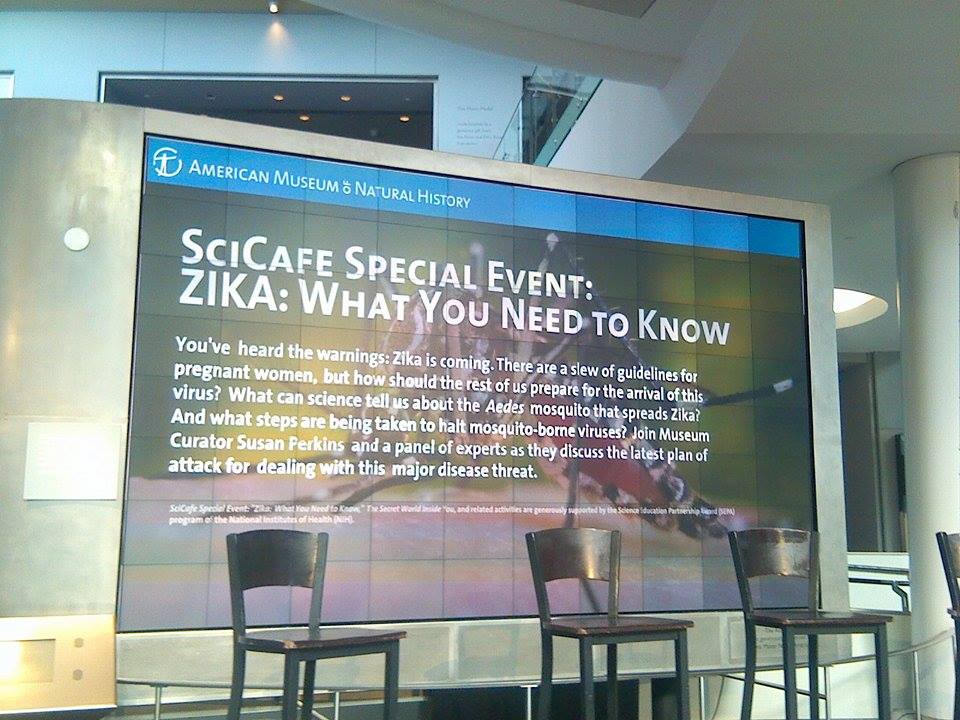 |
| Zika SciCafe at AMNH. Photo taken by author at the event. |
Prevention
Vaccines for Zika are
still being developed and tested. Even once vaccines are on the market they
won’t completely eradicate the disease. There are multiple forms of Zika, and
while the vaccine may successfully prevent one form, it may actually amplify
the effects of a different strain. Being infected to other viral infections
similar to Zika, like Dengue, can also amplify the symptoms of Zika.
 |
| Cullman Hall of the Universe at AMNH where the Zika SciCafe was held. Photo taken by author at the event. |
Another way to prevent
Zika is avoid getting bitten by mosquitos. On a personal level this means
wearing bug spray, long sleeved shirts and pants, putting up bug screens, and
removing standing water. On a governmental scale, as Jay K. Varma MD, Deputy Commissioner
for Disease Control at the New York City Department of Health and Mental Hygiene, explained at the American Museum of Natural History’s Zika SciCafe,
this means activating new mosquito control programs that include putting
chemicals in standing water which kill mosquito larva, spraying to kill adults,
and informing the public of how to stay safe.
Here are some websites
with more information on Zika:


