Tuesday, July 7, 2015

Mining Part Two


The mine is now filled with water
Not all iron mines were underground like Soudan was. After touring Soudan, my family and I went to Mineview in the Sky, a overlook of what used to be a surface mine in the Mesabi area. In a surface mine, all the mining is done on the surface, without digging mining shafts into the earth.


The iron mined in Mesabi is in a soft type of ore called taconite. Taconite is not nearly as good as the ore at Soudan, and has only a 29% iron content. The iron part of taconite is concentrated into pellets before it's shipped from Duluth and across the Great Lakes to factories.

Taconite is still mined today, and the Mineview in the Sky will be dug up soon to mine more iron.


Me on the huge mining equipment 

Monday, June 29, 2015

Mining Part One


Just by driving around the Iron Range, it was easy to tell that the earth was rich with iron.

The view from Soudan

Old Railroad for transporting ore
The ground was red, the rocks were red, even that lake water was red. My white shoes got partially dyed a rust color. The funny thing is that iron ore is actually a metallic blue, but its dust is red.

The water is red!

The  Soudan Iron Mine was the best source of iron in Minnesota from the time it opened in the late 1800s until it went out of operation in 1962. The ore mined there was hard and had a 62% iron percentage. That’s high enough that two rocks from the mine could be welded together. The hardness of the iron in Soudan also made the mine safer and less likely to cave in than the nearby soft iron mines. Soudan Mine is half a mile deep with 27 levels of mining shafts.

More red water
This does not mean the conditions at Soudan were all that great. When it first opened, there was no electricity, mules pulled the carts for transporting iron ore, and miners had to work in the pitch darkness by candlelight. Their bosses did not provide the candles. The miners had to pay for the candles out of their own pockets.
Lake Vermilion

There is still a lot of good quality iron left in Soudan, but it’s so deep in the earth that it’s too expensive to mine. While the mine was still in production, Soudan’s iron ore was shipped across Lake Superior to factories where it was used to produce a variety of products including weapons for both World Wars.

One of the people on our tour was a metallurgist who travels around teaching and inspecting mines for the company he works for. He told us that the iron used to make steel today is of a much poorer quality than the Soudan iron, but it’s cheaper.

Soudan hasn’t gone completely out of use. There are now tours for the public, and there is currently a physics laboratory deep in the mine that is working on subatomic research.

The ore. The blue is the iron
Bats and some mysterious microorganisms inhabit the mines. Once, some scientists spotted some bubbly and flammable water coming out of a drill hole at Soudan half a mile underground. There wasn’t supposed to be any methane at Soudan, so it was puzzling why the water was flammable. They took samples of the water, and when it was tested, they found living organisms in it that were feeding off the iron and producing methane. I find it amazing that organic life is living off iron that far underground.

The view from Soudan is also beautiful. If you happen to be up in the Iron Range I suggest you visit!


Elsewhere in the Iron Range we saw a fawn!


Friday, June 19, 2015

Fish!

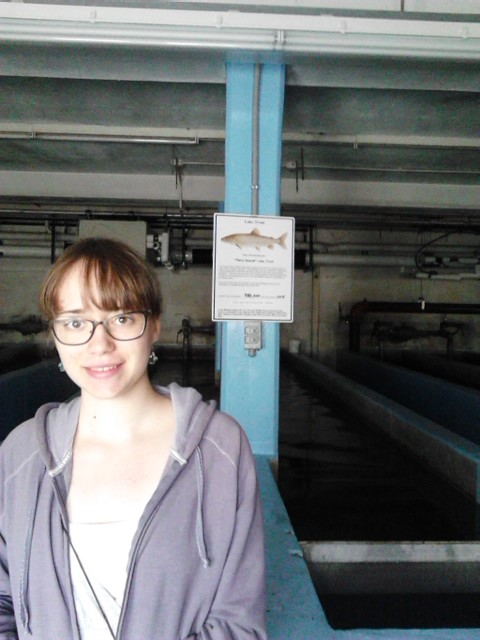
Most of the time, scientific facilities are locked up and difficult to get in to. I was surprised to find this was not the case at the Jordan River National Fish Hatchery near Elmira, Michigan. Anyone could just walk around and check out what was going on.

One of the buildings
My family and I decided to visit the fish hatchery on the spur of the moment as we were driving by. We saw a sign that said “Visitors Welcome” so we turned around and drove right in. You can’t go wrong with fish, right?

This fish hatchery breeds different varieties of trout to replenish fish populations in the Great Lakes. They produce about three million lake trout annually. That’s a lot of fish.

Close up.
Some fish hatcheries grow their own eggs, but this one doesn’t. It used to, but the water from the springs near Elmira (which produce 5,000 gallons of water per minute) is too warm to grow eggs successfully. Instead they ship in eggs from a broodstock facility in Wyoming through FedEx. A worker told us that during the first few weeks of development fish eggs are very delicate, and moving them could be damaging. But after a while, the eggs get tougher, and if they’re securely packed up in wet paper towels, shipping them is just fine.


The Jordan River National Fish Hatchery has three buildings for raising trout at their different stages of development. The tank room is where the eggs are hatched and the fry are raised until they reach fingerling stage. The tanks have a current in them, so all the fry face the same direction. 

After the fingerlings are big enough they’re moved to a bigger building with 80ft long raceways for the fish to swim in. 


Pretty road near the fish hatchery.

Once they reach yearling stage, the trout are moved to the final building, and then once the trout are deemed big and healthy enough, they are taken 40-60 miles out into Lake Michigan and released into the wild. Just thinking about a lake that is so big you can be on the water 60 miles away from shore blows my mind.


The nice thing about The Jordan River National Fish Hatchery is that visitors can walk around all the rooms freely. The visitor’s center, with a bathroom and hot water for tea, is open 24/7. The staff are friendly and informative. Overall I give the place a five star rating.

Lake Michigan is also nearby

Right by The Jordan River National Fish Hatchery is a scenic road that goes right by the Jordan River. It is so beautiful I seriously thought I was in fairy land.

Tuesday, June 2, 2015

A Dangerous Drug: Elixir Sulfanilamide


Once, a medicine with antifreeze in it was prescribed to children as a cure for sore throats. It ended up killing them. How did something like this ever manage to happen? Well, it all started with trying to make Sulfanilamide a liquid.

This incident was the Sulfanilamide disaster of 1937, which I recently learned about in my pharmacology class at the ROC taught by Dr. Sonia Houston Pichardo, PhD.

Sulfanilamides were the first powerful anti-bacteria drugs discovered in 1932 by Gerhard Domagk. They were used widely during World War II in powder and tablet form to prevent infection. In 1937 a drug manufacturer S. E. Massengill Co., decided sulfa drugs were so effective they should develop a liquid form to treat infection in children who couldn't easily swallow tablets.

The chemist in charge of the project, Harold C. Watkins soon found sulfanilamide dissolved in diethylene glycol, a clear odorless substance that tasted sweet. Perfect! Not. It ended up that diethylene glycol was a deadly poison used in antifreeze.


"Elixir Sulfanilamide" by Unknown

Back in 1937 there were no laws requiring that drugs be tested before being sold to the public so Elixir Sulfanilamide was put right on the market. In fact, at the time, there were no laws against selling lethal drugs at all. The FDA did exist, but it had little power and its Food and Drug Act of 1906 was not enforced. The new form of sulfanilmide was  prescribed to children without ever being tested.

Soon both kids and adults began do die as a result of taking Elixir Sulfanilamide and the American Medical Association suspected something fishy was going on and had this new drug form investigated. The symptoms of poisoning lasted about 7-21 days and resembled kidney failure. The drug meant to cure these kids of a sore throat ended up killing them in an excruciatingly painful way. The AMA found that diethylene glycol to be poisonous and ordered a swift recall of the drug. Still hundreds of people across the United States died, including Harold C. Watkins who committed suicide when he learned his drug was a killer

 The FDA and AMA recalled 234 gallons and 1 pint of the 240 gallons of Elixir Sulfanilamide distributed. Despite the horrible consequences of Elixir Sulfanilamide even getting on the market the only fine S. E. Massengill Co. was one for mis-branding, as the name "elixir" suggested alcohol was involved in the drug when it wasn't. If the drug had been called  Solution Sulfanilamide instead, the company would have received no fine at all.

The only good thing Elixir Sulfanilamide did was worry the government enough to make and enforce laws requiring drugs to be tested before they were put on the market. The Federal Food, Drug, and Cosmetics Act was put into practice in 1938.  Thank goodness! This law helped prevent anything like the Sulfanilamide disaster from ever happening on such a great scale again.


Monday, May 25, 2015

Enthusiasm is Catching, Entomology Edition

This past week I went to a meeting of the New York Entomological Society at the American Museum of Natural History.

Before the lecture I was actually reading a book about entomology, which I posted about a few weeks ago, and I just read that beetles and caterpillars will drop out of the trees if they sense a predator approaching. Right after reading that, I stepped out of my apartment on the way to the entomology lecture, and I saw a caterpillar on the city sidewalk, vigorously crawling back to it's tree home. The caterpillar was probably using the escape method I just real about. What timing! It's not every day that I read about a concept, go outside and see it demonstrated for me. Since the caterpillar was in danger of being stepped on, I rescued it and put it back on the tree.
Rescuing the caterpillar.

The entomology event was fun, and the talk was easy to follow for a lay-person like me. Louis Sorkin, who I've also mentioned before in another post, started off the evening by talking about insects as food. He is very enthusiastic about people eating bugs, despite the fact that he himself is allergic to mealworms.

The caterpillar happily crawling up the tree.

Next on the evening's agenda, Richard Falco, Ph.D. talked to us about tick and mosquito activity in the NY area for this summer. He told us not to believe any of his predictions, but there should be medium-high tick activity and medium-low mosquito activity this year. Now we'll have to see if his predictions come true!


Monday, May 18, 2015

Warm Blooded Fish (?)

My drawing of the opah
I love how what we accept as scientific "fact" is constantly changing. It just goes to show how amazing the universe is and how little we really know about it.

Recently scientists Nicholas C. Wegner, Owyn E. Snodgrass, Heidi Dewar, and John R. Hyde, discovered  the first known warm-blooded fish. When I first heard the news I was shocked. "But, fish are cold-blooded! They're not mammals!" Then, I read an article on the subject and I went from shocked to intrigued.

The fish, known as the opah (Lampris guttatus) lives in the very depths of the ocean where it is extremely cold. Most fish living at this depth are slow moving, but the opah is a fast moving predator with characteristics similar to predators that live nearer the surface. It's sluggish prey barely stands a chance.

The opah generates its heat by beating its pectoral fins constantly and quickly. This warms up the blood which warms the body circulates. A mechanism in the opah's gills allows the warm oxygen-poor blood, to transfer its warmth to the cold oxygen-rich blood. This process, known as "counter-current heat exchange," keeps the warmth concentrated in the opah's core. 

The opah is not as warm as mammals, but it does maintain a body temperature five degrees Celsius above the temperature of the surrounding water. Being warm has many evolutionary advantages, especially for a predator, as it allows the animal to move faster and have bigger eyes.

No fish yet discovered are as endothermic as the opah, but some fish like tuna have regional endothermy in their eyes, liver, and swimming muscles. Some people like Professor Diego Bernal, think that the opah is just another ectotherm with regional endothermy. Since the opah is warmest at its core, but gets colder near the outer edges, this is a possibility, but no matter what it's a pretty unique fish.


Tuesday, May 12, 2015

Multitude of Insects

Butterfly Room at AMNH
Insects are everywhere. Over 900,000 currently known species live with and around us, and most of the time we barely even notice them. Tiny mites cover our skin, house pests inhabit our homes, and millions of insects make the great outdoors their home. Yet, most of us still don't even acknowledge these bugs. It's like they are part of a whole alternate universe.


I'm not a huge fan of insects, but they don't petrify me either. I simply just don't think about them much. After meeting Louis Sorkin in my Tree of Life class at the American Museum of Natural History, and reading How Not to Be Eaten: The Insects Fight Back by Gilbert Waldbauer, I became more interested in creepy-crawlies. Here's some cool stuff I recently learned about them.
  • Insects are the most widely available source of animal food on the planet and most animals, other insects, and even some humans will readily eat them. Insects have developed countless ways to evade predators and predators have developed countless ways to catch and eat bug
  • Flying insects are another great food source for birds and bats. Swallows and swifts fly at different heights in the air divided by species to avoid competing for food. Kingfishers aren't into cooperation, they viciously fight off any possible competition in their territory.
  • Have you ever wondered how cockroaches manage to scurry away so quickly? Well, cockroaches and other insects like them have light and touch sensors on their tail end so they are aware of approaching predators or angry humans at all angles. They know we're there before we know they're there.
  • Burrowing owls place dung around the entrances to their burrows to attract their favorite snack, dung beetles. Some researchers once removed the dung, and the owls became agitated and began to bob up and down in distress.
Not only are insects fascinating, the people who study them get to do some interesting stuff at their jobs like help the police investigate homicides. Louis Sorkin told my class that entomologists can look at the insects found in a corpse and tell how long the body has been expired, based on how developed the insects are, and whether or not the body was moved, based on what type of insects are in the corpse and what area they are native to. Aren't bugs amazing?

Butterfly Room at AMNH

As I continue to read How Not to Be Eaten: The Insects Fight Back I'm excited to learn more about insects. I have to say bugs are a little less creepy when you learn about them, but I'll still jump and shudder every time I find a cockroach in the kitchen.