Monday, March 30, 2015

Stone Tools Speak

A common misconception about early humans and their relatives is that they were rough people with primitive tools. Even if our early relatives weren't as technologically advanced as we are, they were by no means primitive.

Yesterday in my class on human origins at the American Museum of Natural History, we studied stone tools, and an archaeologist named Glen came and actually made a stone tool right in front of us during the class. He finds that actually making stone tools helps him in his research because he can understand the process early humans went through to use and make them.

An Acheulean hand-axe from Douro Valley in Zamora, Spain.
Art by Josè-Manuel Benito Álvarez.
The process of making stone tools is known as flint knapping. To make a tool, like let's say a battle axe, flint knappers tap their blank (the stone that will eventually become the tool) with a billet (a tool used for striking the blanks). Blanks are made of stones like flint, obsidian, and chert because these stones are made out of the same material throughout so they break predictably. These stones are also hard, and they make good sharp tools. Billets, on the other hand, are made of softer material, like copper or antler.

Tapping the blank with a billet creates pressure waves in the rock which cause it to break into neat shards. When a shard breaks off, it has wave-like ridges on it. These ridges have the shape of the pressure wave that broke the rock. A pressure wave takes about a millisecond to break a blank, but the pressure wave marks stick around for thousands of years.  I think it's cool how a rock shard from thousands of years ago can document one millisecond of history.

Stone tools require skill to make and are extremely sharp. A fresh shard of rock is sharper than steel can ever be, but it dulls faster. This problem can be fixed easily by tapping off a fresh edge for the stone, or by just making a new tool. We got to test out the sharpness of leftover shards from the spearhead Glen made on apples, carrots and bananas, and they cut almost as well as any knife.

Tools made using the Levallois technique.
 Specimen from La Parrilla, in Valladolid, Spain.
 Art by Josè-Manuel Benito Álvarez.
Stone tools were not only useful for prehistoric humans, they help archaeologists today study and understand the past. Stone tools are great additions to the fossil record because, being stone, they preserve well and they can tell researchers many things, from what early humans were hunting to how advanced their language development was.

At first I was confused as to how stone tools could give us any information about language development, but now that I think about it, it makes sense. Complex tool stone tools were difficult enough to make that it would have taken pretty advanced communication skills to teach anyone how to make them. Also, as time passed, tools like spears became more popular than the good-old hand axe.  Spears, however, couldn't kill an animal with one blow. To use the spears effectively, early humans would have had to work in a group with an advanced plan of attack. Plans require good communication abilities.

It ends up that "primitive" stone tools are actually markers of an advanced society with a spoken language.

Monday, March 23, 2015

Why Be Bipedal?

I've been thinking about hominins lately, because of a class I'm in at the American Museum of Natural History on human origins.

When a primate fossil is found, researchers try to figure out what group of primates it belongs to. One of the key features for determining whether or not a fossil belonged to a hominin, is to tell if it was bipedal, ie. walked on two legs.Ways to tell are to see where the foramen magnum exits the skull (directly underneath for bipedals, back for quadrupedal), and if the femurs are angled in or not ( angled in femurs are a sign of bipedalism). It's funny that you can tell how an animal walked by its head, but it makes sense because the heads of quadrupeds stick out in front of their bodies while the heads of bipeds sit directly above their bodies.

There are countless theories about why hominins and their descendants (us!) gave up living in trees and walking around on all fours for standing upright. The thing is, bipedalism isn't completely beneficial. Bipedals are much more prone to lower back and knee problems, and they also tend to be weaker than quadrupeds.


A Man Running by Eadweard Muybridge
Hominins are bipedal, but the question is why? Why bother being bipedal in the first place?
Some benefits our early ancestors had due to being bipedal were: the ability to see over tall grass, the ability to carry children etc., more cooling regulation because less of the body is directly exposed to the sun, more energy efficient movement, and the ability to make and use tools and weapons. Some sexual selection may have also played a role.

The most intriguing theory of all of these, in my opinion, is energy efficient movement. Walking on two legs takes less energy than doing the same thing on four. Also, hominins have less hair and sweat more than other animals, allowing them to cool off while moving rather than having to stand in the shade for awhile. Freed hands allow hominins to carry provisions for long journeys. All these abilities allow hominins to persistence hunt, or run down an animal till it dies of exhaustion. This method of killing, still used today by some tribes in Africa, allowed hominins to obtain high caloric meat even without advanced weapons.

Some scientists get in heated arguments over the specific reason for bipedalism, but the truth is that all of these factors probably played a role, and we may never know exactly what happened.

Thursday, March 12, 2015

Piltdown Man

One of the worst, and funniest, mistakes in the history of science involves the case of Piltdown Man.


Group of men examining the skull of Piltdown man.
Painting by John Cooke, 1915. Used with permission under Creative Commons.
In 1912 the skull and jaw of a hominin were discovered in a gravel pit in Piltdown, England. The skull was old, but looked modern due to it's large size. The jaw, however, was brutish and primitive. Piltdown Man led scientists to believe that large brains developed before bipedalism. This idea caused many other bipedal hominin fossils to be classified as apes due to small skull size, when these fossils actually did belong to hominins.

By the 1930s more and more bipedal hominin fossils with small skulls were discovered making Piltdown Man seem like an unusual case.

Finally, in 1953 Piltdown Man was found to be a fraud! The skull came from a modern human, which explained the unusually large size, and the jaw was from an orangutan. The bones were stained to make them look older, and the jaw attachment was filed down so it was not obvious that the bones weren't even from the same species.

Another bone found in the same pit as Piltdown Man was carved in the shape of a cricket bat. The person who put the bones there probably thought this would give the joke away since no animal has cricket bat bones. But no, this bat-shaped fossil was thought to be real too!


The identity of the hoaxer remains a mystery, but a man named Martin Hinton is the main suspect. He was an expert on rodent fossils who worked at the Natural History Museum. He had the technical knowledge to carry out the joke, and he also had a grudge against his boss, Arthur Smith-Woodword, who became one of the main supporters of Plitdown man.

I found out about Piltdown Man in the book The Accidental Species: Misunderstandings of Human Evolution by Henry Gee, and I just had to do a blog post about it. The case of Piltdown man illustrates how important it is to question and evaluate scientific discoveries before accepting them. It is hilarious how a joke like that went on for 41 years.


Saturday, March 7, 2015

Psycopaths

The other day I went to the library near 116th Street in Manhattan and picked up a book called The Psychopath Inside by James Fallon. I've read a couple books on psychopaths before (The Psychopath Test by Jon Ronson, and  Confessions of a Sociopath by M. E. Thomas), but this particular book from the library interested me because it was written by a neuroscientist who was a borderline psychopath himself. Actually the only thing that kept him from being a full-out killer psychopath was that he hadn't killed anyone and did not have the desire to do so.

The question is why isn't he a killer when these other similar psychopaths are?


Psychopaths are known to lack empathy but are gifted at judging situations in a purely rational sense. Psychopaths are often popular and successful people because they are so rational. Empathy does not get in the way of their climb to the top. Psychopaths are unafraid of danger or hurting other people, and as a result tend to hurt or endanger others without thought.

One of the reasons for their risk-taking is that psychopaths have little or no brain activity in their anterior cingulate cortex, the area of the brain responsible for hot cognition, or decision making based on empathy.

On the other hand, psychopaths have increased brain activity in their dorsal prefrontal cortex, the area of the brain responsible for cold cognition, or rational decision making. Genetics are thought to be responsible for the lack of activity in almost all empathetic parts of the psychopathic brain because psychopathy tends to run in families.

Now, why aren't all psychopaths killers? From what is known today, it seems that psychopathic killers were more likely abused as kids, while psychopaths with a nicer upbringing tend to simply grow up into ruthless adults.

This book is an entertaining read and I would recommend it to anyone interested in neuroscience.

Friday, February 27, 2015

Language Matters

On February 18, I went to a screening of the film Language Matters at City Lore, a gallery on East 1st Street on New York City. The film focused on three places in the world with dying languages: the top end of Australia, Wales, and Hawaii. In all these places, English has taken over and the original languages are at risk. There are over 6,000 languages in the world, and about half of them are expected to die out by the end of this century. Watching Language Matters inspired me to learn more languages.

Flyer from the event
English, Spanish, and other world-dominant languages began to replace other languages during the era of colonization. The schools established in colonized areas were generally taught in English only, and children were often forbidden or even punished for speaking their first language. The prohibition against speaking indigenous languages resulted in people speaking more and more English.

In Wales, any child caught speaking Welsh in school was forced to wear a sign called a "Welsh Not" around their neck, and at the end of the day, the child would be punished by a whipping. In Hawaii and Australia, similar efforts were made to force students to speak only English, and most of the time the efforts worked. Children stopped speaking their first language and stopped passing it down to their own children. The language then died a slow death, and the set of knowledge that went along with it disappeared too.

Now the era of colonization is essentially over, and people are starting to make efforts to preserve their languages. In Wales and Hawaii, there are schools for children that are taught only in Welsh or Hawaiian respectively. In Australia, schools are still taught in English, but the elders of many villages where the original languages are still spoken are making sure the languages will be passed on by teaching them to all the children. In all three areas covered in Language Matters, song was used to pass on language and culture.

Another valuable way to preserve a language is by writing it down and making a record of it, and that is the job of ethnographers and linguists. Having a written record of a language is both helpful to science and to the people who speak the language. In the past, scientists often took from cultures without giving back, as in the case of Minik and Robert Peary, but today scientists try to create mutually-beneficial relationships.

Mono-linguistic society is a new concept. In the past, people were generally multilingual.  Each language offers its own unique way of viewing the world, and in losing languages, we lose diversity of thought.


The words of a language provide windows for us to see the world through.

Friday, February 20, 2015

Cyanotype Printing Experiment (somewhat successful)

Last week I went to a program for teens at the Metropolitan Museum of Art about photography. At first I was a little nervous about this workshop. Photography is not really my thing, and the only photos I take are for this blog. But then, I found out that part of the workshop was on the science of photo preservation. Once I found that out, I started to get excited. "Science," I thought "Yes, I can do this!"
My original cyanotype

In the photo preservation class, we made cyanotype prints. This printing process was invented by Sir John Herschel in 1842 when he realized that ferric (iron) salts, in combination with some other salts, could be reduced to a ferric state by exposing them to ultraviolet light. In this state, the salts could be used to create a blue and white image. In that same century, Anna Atkins published the first ever book with photographs, instead of drawn illustrations, using cyanotype prints of algae.

Cyanotype in sodium bicarbonate
I used lace, a feather, printed napkins, ribbons, and a leaf to make a design for my print. Cyanotypes can be exposed using sunlight, but in my class we used a UV ray machine since we were in a photography lab, and it happened to be late afternoon on a winter day when UV rays would be insufficient.

The bleached cyanotype
Cyanotypes have a blue background and white images. However I did not want my print to be just plain blue and white. Luckily one of the cool things about cyanotypes is that they can be bleached using sodium carbonate, or sodium bicarbonate (baking soda) and then dyed a new color with tea or coffee. The sodium carbonate or bicarbonate breaks down the iron so that the tannin in the dye can latch on more easily.

Cyanotype in the tea
I used sodium bicarbonate to bleach my print. The fact that sodium carbonate and bicarbonate bleach cyanotypes shows that base environments are not good for storing photographs, as they might fade the photos.

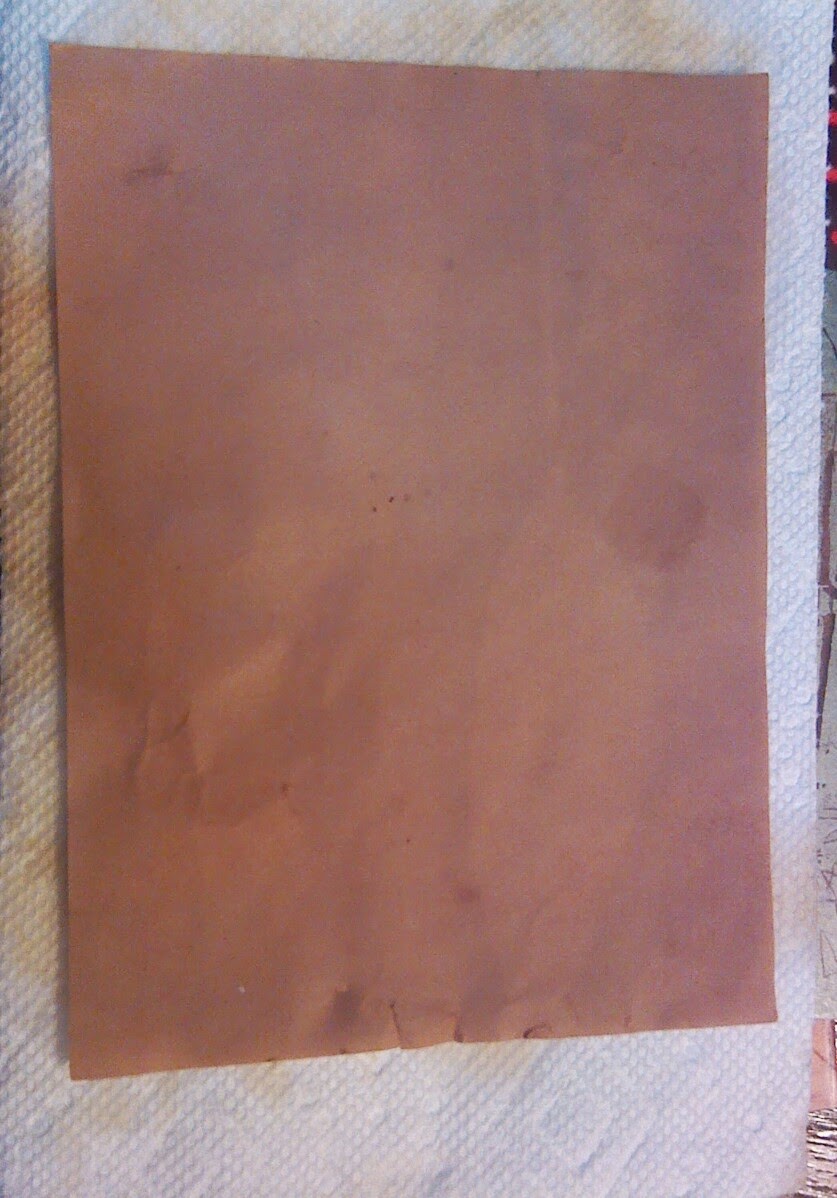
The dyed cyanotype.
Not exactly what I envisioned.
After bleaching my cyanotype, I soaked it in black tea for about 24 hours. The dying process did not go as well as I planned as the whole paper turned brown, not just the background.

Well, I guess I'll just have to try again to see if I can get a nice brown and white print!


Thursday, February 12, 2015

The Real Reason McDonald's Burgers Don't Rot

Have you ever heard the myth that McDonald's hamburgers don't rot because they are full of dangerous chemicals? Well, I recently read an article by J. Kenji Lopez-Alt which shows that while McDonald's does not supply great food, there is no reason to believe their burgers and buns have anymore chemicals than the burgers and buns at an ordinary supermarket.

Barely any mold grew on these dry potato flakes
  J. Kenji Lopez-Alt made a homemade burger roughly the same size as a standard McDonald's burger and kept them both in the open air right next to each other for 25 days. Neither burger rotted because they both dried out! Since living organisms can't survive without water, it's no surprise that mold didn't grow. The faulty conclusion in previous experiments with McDonald's food that just won't decompose is due to bad experimental procedure that was all experiment with no control.

These wet potato flakes exploded with mold
   I recently conducted a few experiments myself on what conditions are best for growing mold, and I found warm, dark, and moist locations are far superior to dry, light ones. So it's no wonder that two relatively small burgers left out in the open dried out before mold had any chance to grow.

   J. Kenji Lopez-Alt also conducted another experiment where he kept both a McDonald's burger and a homemade burger in sealed plastic bags. This time both burgers rotted because the plastic trapped the moisture.

   While there are still countless reasons to dislike McDonald's and assume that their food is unhealthy, just read Fast Food Nation or watch Super Size Me, but the fact that their burgers don't rot isn't one of them.